The Argus
Heart of the HunterThe Argus is a newspaper whose coverage helps turn Thobela Mpayipheli’s flight from an intelligence pursuit into a public argument over identity and credibility. Its pages move between newsrooms, interview rooms, and the offices of the people directing the hunt; most decisively, a front-page headline identifies the fugitive biker as an MK hero. The paper matters not simply as a source of news but as a vehicle through which competing accounts of Mpayipheli become visible and politically consequential.
Circulation and the news network
The Argus appears as part of a daily press flow that connects regional reporting to national broadcasting. A consignment of newspapers reaches the news editor of the SABC morning television programme at Auckland Park in Johannesburg. The pile includes the previous day’s Argus alongside that morning’s Burger and Cape Times. The editor surveys the papers as part of his routine assessment of the southern news team and its competition, then reads a Cape Times report on the big, bad BMW biker. That distinction matters: the account he reads is attributed to Allison Healy, a Cape Times crime reporter, while The Argus is one of the circulating publications through which the wider story travels.
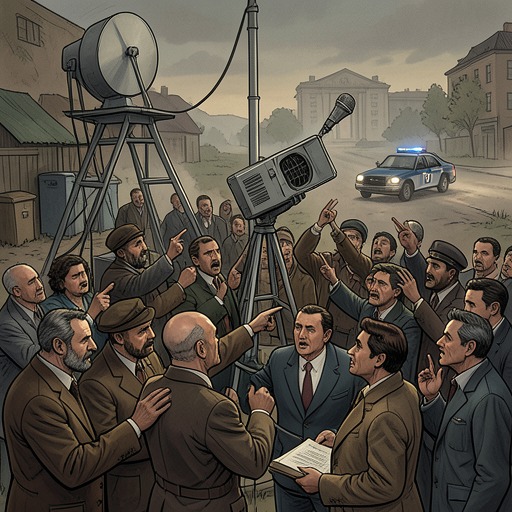
The newspaper’s circulation also reaches the intelligence operation itself. Quinn places an issue of The Argus carefully in front of Janina Mentz, making its headline an object for the unit to confront rather than a distant item of public chatter. In a story where officials monitor telephones, shape pursuit plans, and debate how to manage news coverage, a newspaper brought into the room carries the outside public narrative directly into the command structure.
The headline and the soldier’s past
The Argus front page declares that the fugitive biker was an MK hero. Its accompanying report presents Mpayipheli as a former Umkhonto we Sizwe soldier who served the Struggle with distinction, relying on the testimony of Colonel Luke Mahlape, a former South African National Defence Force officer and comrade. Mahlape says that although he lost track of Mpayipheli’s military career during the latter part of the struggle against apartheid, he regarded him as an honourable soldier.
Mahlape contacts The Argus to set the record straight after Mpayipheli’s high-speed journey across the country on a large BMW motorcycle has become a local headline. The resulting article does not erase the immediate fact of the manhunt; instead, it puts that present-tense image beside a military past that complicates the label of dangerous fugitive. The paper’s framing therefore restores a history that the pursuit’s official shorthand leaves out. A wanted man can also be remembered by a former comrade as a soldier of honour, and the headline forces those descriptions into the same public view.
News as counterclaim
The Argus’s headline returns as a point of reference in a conversation with Orlando Arendse. Asked whether he has seen the day’s paper, Arendse confirms that it calls Mpayipheli a war hero. The exchange shows the report reaching beyond the newsroom: the headline is now part of how people discuss the fugitive, even in a conversation about his inclination to violence. It supplies a competing description, not a final verdict.
That contest over credibility also surrounds the separate reporting by Allison Healy. On television, she challenges the claim that Mpayipheli stole the BMW: the dealership owner says he left a note explaining that he had to borrow it and would pay, while no theft charges or investigation have followed. She also asks why the government has not publicly corrected the account if he is guilty of an offence. Those claims are Healy’s, not The Argus’s; their relevance is that the book places the newspaper’s soldier-hero framing within a broader struggle over how the pursuit is reported and whether official allegations withstand scrutiny.
Place in the media contest
The Argus operates within a media environment that intelligence officials regard as a strategic problem. When the Minister considers what to do about press attention, one proposed course is to use the media to the government’s advantage. In that setting, a headline that presents Mpayipheli as a former liberation fighter is more than background information: it demonstrates how reporting can unsettle the official image of an armed and dangerous fugitive and shape the terms of public discussion.
The paper is not shown as a single, fully characterized editorial voice, nor does the evidence establish that it independently resolves the truth about Mpayipheli. Its narrative function is more specific. The Argus carries a former comrade’s testimony into public circulation, places that testimony before the intelligence unit, and supplies a phrase that Arendse recognizes in conversation. Its pages make the struggle over Mpayipheli’s past legible: the state pursues a fugitive, while the newspaper’s headline insists that the pursued man also has a history as a soldier remembered with respect.